
Southeast Pulaski County
Demolition Little Rock: Demolition in Wrightsville
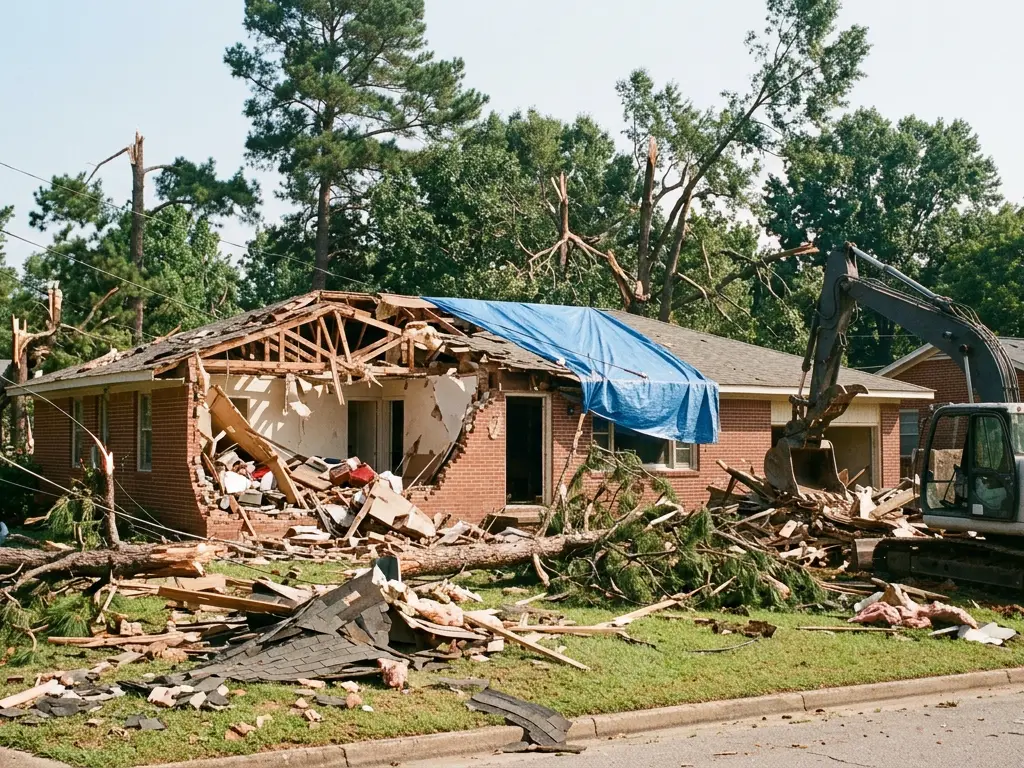
Older rural houses, barns, sheds and mobile homes on the heavy clay of southeast Pulaski County, cleared and graded so the ground drains.
- Little Rock and 12 nearby towns
- Written price before work starts
- Permit and utility steps explained
- Houses, pools, garages and slabs
- Lots left level and swept
Demolition Little Rock arranges demolition in Wrightsville, the small Pulaski County city of about 1,500 people (2020 Census) in the southeast of the county, about 11 miles from Little Rock's center point. Much of the area is rural, so the work is older houses, barns, sheds and mobile homes, and the heavy clay underfoot shapes how every site is finished.
Taking down a failing farmhouse near Wrightsville typically costs $7,500 to $15,000; leaving it to collapse on its own can cost far more than the $15,000 end of that range once the wreckage is tangled with trees and fencing.
Describe the building, its size and what it is made of, and hear a typical price range before anyone drives out.
Call (501) 222-3828Signs on a Wrightsville property that a building should go
- A farmhouse on piers with sagging floors and a failing roof
- A barn leaning after a storm
- A mobile home that has been empty for years
- Cracks in brick or block walls that open and close with the seasons
- Sheds and carports rusted or rotted through
Moreland silty clay
At Wrightsville's Census point the USDA soil survey maps Moreland silty clay, somewhat poorly drained and in hydrologic group D. Clay like this swells when wet and shrinks when dry, which is one reason older foundations here crack and move, and one reason demolition sites need careful grading: an excavation in clay holds water, and a lot left flat stays muddy.
After a teardown, footing holes are filled with compacted soil rather than left as pockets, and the lot is shaped to drain toward a ditch or low corner.
Rural demolition, done in one trip
Distance from the landfill and the equipment yard adds to every rural job, so it pays to combine work: a house, a barn and a mobile home cleared in one mobilization costs less than three separate jobs. The barn demolition page covers salvage of old wood and tin, which is often worth keeping on a farm.
Describe the building, its size and what it is made of, and hear a typical price range before anyone drives out.
Call (501) 222-3828Permits and the county
Inside the city limits, ask the City of Wrightsville about a demolition permit. On unincorporated land around it, Pulaski County applies. Utilities are disconnected by their providers, and a rural property's well or septic is dealt with before the house comes down.
Describe the building, its size and what it is made of, and hear a typical price range before anyone drives out.
Call (501) 222-3828Old farmhouses and what they are built on
Many older houses around Wrightsville sit on brick or block piers rather than a slab, with a crawl space underneath and wood floor framing that has spent decades over damp clay. When a house like that comes down, every pier and its footing comes out, not just the visible skirting, and the crawl-space area is graded so it does not leave a shallow pond. Old houses here also tend to have had additions over the years, a back porch closed in, a room added on a different foundation, so the crew checks for more than one foundation type before it starts.
Wood from old farmhouses, like barn wood, sometimes has salvage value. Heart pine flooring and old beams can be set aside if you want them.
Questions people ask
How much does demolition cost near Wrightsville?
A typical house runs $7,500 to $15,000. Barns run $1,200 to $25,000 and mobile homes $2,000 to $6,000.
What are the signs an old farmhouse should be torn down?
Sagging floors on failed piers, a failing roof, walls cracking with the seasons, and years of vacancy.
Why does clay soil matter for demolition?
The USDA soil survey maps shrink-swell Moreland clay here, so holes hold water and lots need grading to drain.
Can you combine several buildings in one job?
Yes. A house, barn and mobile home cleared in one trip costs less than three separate jobs.
Who issues permits in Wrightsville?
The City of Wrightsville inside the city limits; Pulaski County outside them.
What happens to the well and septic on a rural Wrightsville property?
A septic tank is pumped and properly abandoned or kept for a new home, and an unused well is capped or plugged. Mark both before the crew arrives so machines stay clear of them.
Have something that needs to come down?
A house, a garage, a pool or a slab. Call with the address and the size, and get a typical price range and the permit steps that apply to it.
Call (501) 222-3828