
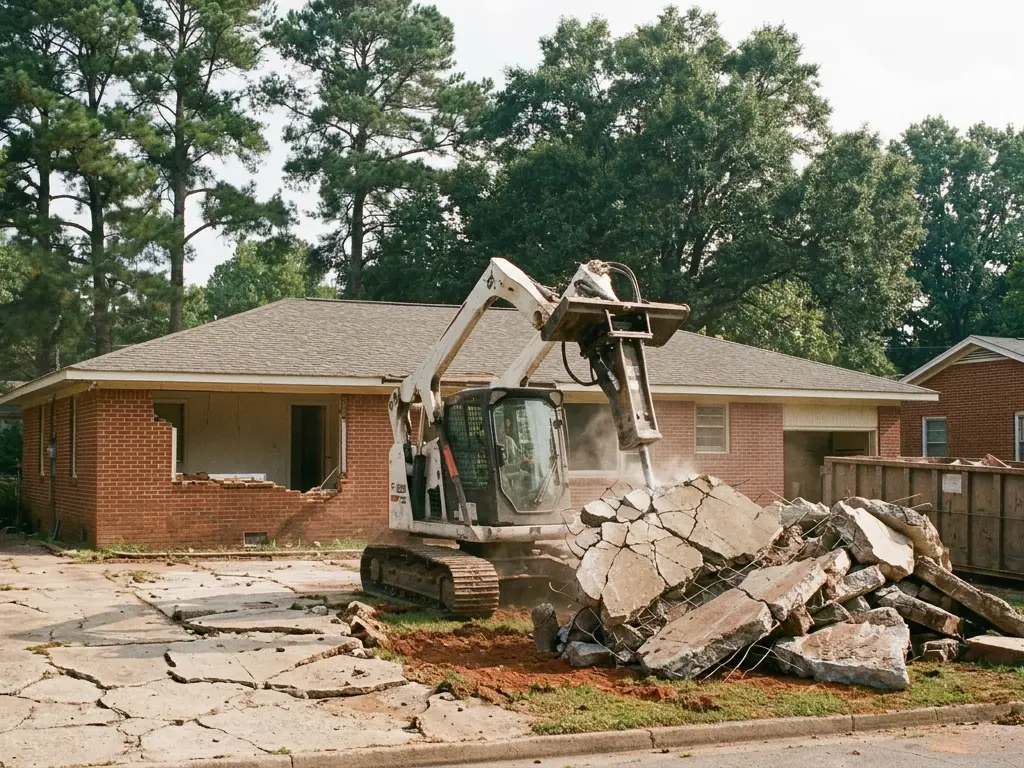
Where owners lose money
Demolition Little Rock: House Demolition Mistakes to Avoid in Little Rock
Eight mistakes that turn an ordinary teardown into an expensive one, each with the cheap step that would have avoided it.
- Little Rock and 12 nearby towns
- Written price before work starts
- Permit and utility steps explained
- Houses, pools, garages and slabs
- Lots left level and swept
Demolition Little Rock put this list together from the problems that come up after demolitions go wrong, around Little Rock and everywhere else. Almost none of them come from the excavator. They come from steps skipped before the machine arrived or after it left, and almost every one is cheaper to prevent than to fix.
Removing footings and compacting the holes at demolition time costs roughly $1,000 to $3,000; skipping it can cost a builder $5,000 to $20,000 later, which makes it the most expensive mistake on this list.
Describe the building, its size and what it is made of, and hear a typical price range before anyone drives out.
Call (501) 222-38281. Starting the paperwork too late
The City of Little Rock wants a sewer seal before it issues a demolition permit, and gas and power must be cut at the street by the utilities. Owners who book a contractor first and call the utilities second often wait weeks with a crew on hold. Make those calls the week you decide.
2. Assuming there is no asbestos
A house built before the 1980s can have asbestos in siding, floor tile, ceilings and pipe insulation. Demolishing through it spreads fibers, can draw state enforcement on covered jobs, and costs far more to clean up than to test for first. Testing runs about $500.
Describe the building, its size and what it is made of, and hear a typical price range before anyone drives out.
Call (501) 222-38283. Comparing quotes on the total alone
A low quote that leaves out the foundation, the driveway, the haul or the grading is not cheaper; it is a smaller job. Line quotes up against the same list of what comes down, who handles the permit and seal, where debris goes and how the lot is left. The cost guide has that checklist.
4. Leaving the footings in the ground
Old footings and piers left buried are invisible until the next foundation is dug. Then they mean redesign, delay and extra excavation. Have them removed and the holes compacted at demolition time, especially on a teardown and rebuild.
5. Not asking where the debris goes
Demolition debris belongs in a permitted construction and demolition landfill or a recycler. Illegal dumping can come back to the property owner. North Little Rock asks its own demolition contractors for a landfill receipt with every invoice; asking yours for the same is reasonable.
6. Forgetting the trees you want to keep
Machines driving over the root zone of a mature oak can kill it a year later. Fence the trees you want at the drip line before work starts and tell the crew which ones they are.
7. Ignoring the soil when backfilling
Clay and poorly drained silt, common in parts of Pulaski and Saline County, hold water in an open hole. Fill dumped into a wet hole settles for years. Holes should dry, take drainable stone where needed, and be filled in compacted layers, as on the Shannon Hills page.
Describe the building, its size and what it is made of, and hear a typical price range before anyone drives out.
Call (501) 222-38288. Waiting out a condemnation notice
A house left until the City acts is demolished under the City's contract, on the City's schedule, with the cost able to come back to the property as a lien. Acting before the deadline keeps the price and timing in your hands.
Two bonus mistakes on pools and garages
Dumping a pool full without drain holes
A pool filled without breaking holes through the floor becomes a buried tub that holds rainwater, and the lawn over it stays soggy. Drain holes, clean fill and compaction in layers prevent it. The pool fill in page explains the right way.
Cutting an attached garage off without closing the house
An attached garage shares a wall and a roof line with the house. Removing it without framing, sheathing and siding the opening leaves the house exposed. That closing work belongs in the quote from the start.
The cheap habits that prevent most of these
- Make the utility and sewer seal calls the week you decide.
- Test older materials for asbestos before booking a crew.
- Get every quote in writing against the same list of what is included.
- Ask for landfill receipts and keep them with the permit.
- Mark trees, septic lids and wells that must be protected.
- Walk the finished lot with the contractor before the final payment.
None of these takes more than a phone call or an hour of your time, and together they prevent nearly every expensive surprise on this list. Owners clearing lots in Bryant and other fast-growing towns around Little Rock, where a builder is waiting to start, have the most to gain from getting them right.
Mistakes on the paperwork after the job
Two small mistakes show up months later. The first is not keeping the permit, the landfill receipts and any asbestos records. A buyer, a lender or a future builder may ask for proof that the old house was removed properly, and the paperwork answers it in a minute. The second is not telling the county assessor that the house is gone. A demolished building can stay on the tax roll until someone reports it, so check the next assessment notice for the property and ask the Pulaski County or Saline County assessor to update the record if the house still appears.
Questions people ask
What is the most common house demolition mistake?
Starting the utility and sewer seal calls too late, which stalls the permit and leaves a booked crew waiting.
Do I really need to test for asbestos before demolition?
On an older house it is the safe and usually cheaper route. Testing runs about $500; cleanup after an untested teardown costs far more.
Should the foundation be removed after demolition?
Usually yes, especially if anything will be built there. Removing footings adds roughly $1,000 to $3,000 at the time.
How do I know my debris was disposed of legally?
Ask for landfill or recycler receipts. Reputable contractors keep them.
What are the signs a demolition quote is missing something?
No mention of the foundation, the permit, the sewer seal, asbestos, disposal or how the lot is left.
How much does a typical teardown cost?
About $7,500 to $15,000 for a typical house in the Little Rock area.
What is the most expensive demolition mistake to fix later?
Leaving old footings and piers in the ground. They stay invisible until a builder digs for a new foundation, and then they cause redesign, delay and extra excavation that can cost many times what removing them would have cost at demolition time.
Have something that needs to come down?
A house, a garage, a pool or a slab. Call with the address and the size, and get a typical price range and the permit steps that apply to it.
Call (501) 222-3828